
Understanding the Common Service Data Model (CSDM) in ServiceNow
The Common Service Data Model (CSDM) serves as a unified framework that helps organizations manage and illustrate their services and related data…


The reason I got into Organizational Change Management (OCM) in the first place was because I’d seen too many IT platform implementations and projects that should have been successful crash and burn – or in some cases limp across the finish line. Why did these technically solid solutions fail to meet their potential? Frequently, it was because the larger community simply would not embrace them. I can recall too many after-action conversations among team members that included comments such as:
Our team’s angst and, ultimately, the failure of the solution was a result of our working in a vacuum when designing and implementing changes that would impact the behaviors of people across the organization. Beyond our key internal stakeholders, we had fully dropped the ball on communication.
So much of this pain could have been avoided if we had communicated with the line/people managers themselves to ensure they understood the solution and were sending the right signals to their direct reports.
To help your teams avoid some of the pain and suffering I’ve seen and find success with otherwise great solutions, this article will look at the many dimensions of change to consider, the basics of OCM, how to engage and empower your line/people managers so they can more effectively support the change, and ultimately, how to have more improvement efforts embraced by the wider organization.
As a believer in leveraging best practices to avoid recreating the wheel, a concept from the ITIL 4 framework has some good thoughts on how to view change.
The Four Dimensions of Service Management (as shown below) provides a comprehensive picture of each aspect (dimension) we need to consider when delivering products/services and thinking about changes to the organization. When we don’t take the time to address all four dimensions properly, we end up with problems.
The Four Dimensions of Service Management are:
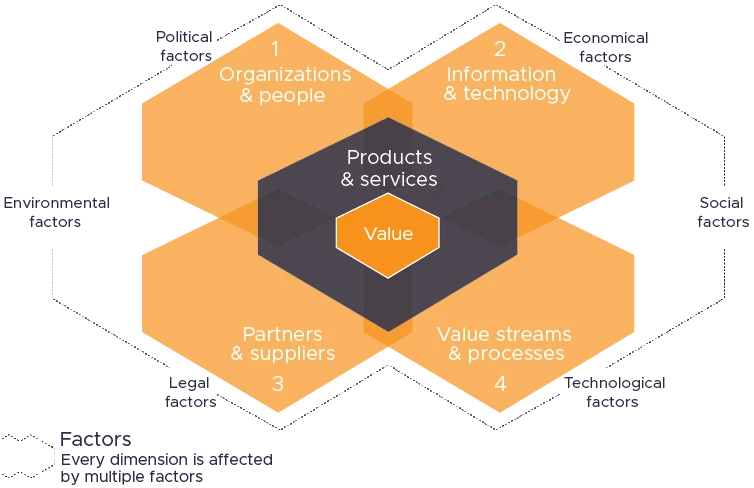
Of the four, our main focus in IT (and this will shock you) tends to be on the Information & Technology dimension. And, to our credit, Value Streams & Processes and Partners & Suppliers dimensions are also typically considered. Where we fall down is with Organizations & People, which is often addressed as an afterthought if at all.
What we’re really doing when we omit this critical component of change is leaving people for last – and that’s a game-ender. Prioritizing the Organizations & People dimension, by which I mean spending significant time and energy getting the team aboard and giving them the information they need to enthusiastically embrace the change and charge forward is critical to the success of initiatives of any size. It cannot be seen as optional.
Sadly, if you build it, they will come only works for attracting old timey baseball players to an Iowa cornfield.
“Project management prepares the solution for the organization while OCM prepares the organization for the solution.”
I really like the saying above, as it describes how good Project Management and OCM can work together. Successful OCM is like considering quality or security: it is not a stand-alone ingredient but rather an integrated, end-to-end approach aimed at achieving a specific result. To be successful, organizations must be intentional with how they carry out OCM, and that intentionality only comes from planning and forethought. Great OCM is baked into projects from the beginning – not bolted on at the end. In order to successfully execute substantial organizational changes, we need three entities working together in concert: leadership, project teams, and change management teams. All three must work together as a well-oiled machine. When they do, they’ll deliver the change to fruition. Our people/line managers form part of the extended group of leaders; I’ll discuss how they fit into this larger picture in the next section. First, here’s a breakdown of what leadership, project teams, and change management teams do from an OCM perspective:
Line/people managers are those whose direct reports are the people on the front lines doing the work that needs to be done across the organization. Common titles for this role are Production Manager, Development Manager, Service Desk Manager, etc. Keeping this group front-of-mind when implementing a change to critical business processes, practices, and workflows is critical to the initiative’s success; they are the make-it-or-break-it cohort. Why? Because:
While it may seem obvious to say this, a line/people manager’s influence with staff and direct reports is deeply personal. Certainly, it is important for leadership to communicate their vision, ideas, and activities through the organization’s official channels, but the really important personal messages, the WIIFM type of communications (What’s in it for me) come best from employees’ direct supervisors, as seen in the graphic below.
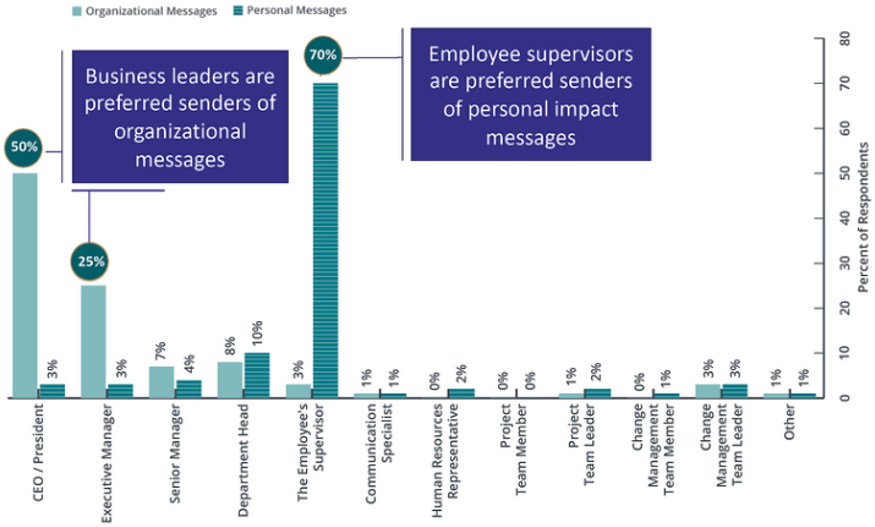
Whether through casual chats, team meetings, or other forms of contact, consciously or even unconsciously, line/people managers set the tone and the expectations for their teams when it comes to key changes. If they don’t believe in the change, none of their staff will either. Losing these managers is often the difference between a successful change and something less.
Resistance to change comes in many forms and from many directions. When we see it, it tells us we haven’t provided employees with the information they need to calm fears and help them adjust to the future the change will bring. As discussed above, who provides employees with this critical information is nearly as important as what is being said, one among many reasons line/people managers are so very important.
Prosci’s Best Practices in Change Management 11th Edition boils resistance down to these five key sources:
Per Prosci’s Best Practices in Change Management, here are a few other opportunities for line/people managers to provide support to their teams throughout a change initiative:
Needless to say, we want to identify these groupings of line/people managers as key stakeholders in a change initiative and treat them accordingly. Since they will be so critical for our success with OCM, we need to provide them with every advantage possible. Prosci’s CLARC and ADKAR models help us provide our line/people managers with the tools needed to be successful in leading change.
Prosci has long emphasized the importance of our line/people managers by defining CLARC roles. These are the uniquely important functions line/people managers play within their existing roles. While we will mention the role of “communicator” here, these functions are so much more than that.
Another key component of the Prosci approach to OCM at the individual level is that of ADKAR:
Below is additional detail on the CLARC roles and what they mean to line/people managers as the organization moves forward with change. Each element of ADKAR has been integrated into CLARC roles for line/people managers to illustrate how they serve as the connection between direct reports, leaders, change teams, and project teams:
Relationship to Adkar: A key job of a line/people manager is to build awareness within the team around the need for this change.
Description: Since the line/people manager’s team trusts them, they make for the perfect source to disseminate information about the organization itself, how the change(s) will impact their work life, and any other relevant messages about projects and other initiatives. An employee’s own direct manager is best positioned to answer questions like, “What does this change mean?”
While a change management team can provide content and critical details, it should be the line/people manager who delivers specific messages and answers questions from their own teams.
What happens without this role? Employees lack awareness around why the organization is making the change. This inevitably increases resistance to change.
Relationship to Adkar: A key job of a line/people manager is to build awareness within the team around the need for this change.
Description: Since the line/people manager’s team trusts them, they make for the perfect source to disseminate information about the organization itself, how the change(s) will impact their work life, and any other relevant messages about projects and other initiatives. An employee’s own direct manager is best positioned to answer questions like, “What does this change mean?”
While a change management team can provide content and critical details, it should be the line/people manager who delivers specific messages and answers questions from their own teams.
What happens without this role? Employees lack awareness around why the organization is making the change. This inevitably increases resistance to change.
| CLARC Role | Relationship to ADKAR | Description | What happens without this role? |
|---|---|---|---|
| Communicator | A key job of a line/people manager is to build awareness within the team around the need for this change. | Since the line/people manager’s team trusts them, they make for the perfect source to disseminate information about the organization itself, how the change(s) will impact their work life, and any other relevant messages about projects and other initiatives. An employee’s own direct manager is best positioned to answer questions like, “What does this change mean?” While a change management team can provide content and critical details, it should be the line/people manager who delivers specific messages and answers questions from their own teams. | Employees lack awareness around why the organization is making the change. This inevitably increases resistance to change. |
| CLARC Role | Relationship to ADKAR | Role Description | What happens without this role? |
|---|---|---|---|
| Liaison | Line/people managers use their liaison role to influence reinforcement to sustain the change. | Line/people managers act as liaisons between the project team and their own reports, exchanging information between the two groups. The feedback they provide from their team to the project team is of particular importance. These line/people managers are in the best position to provide design input, usability results, and employee comments on aspects of the solution to the project team. They are also positioned to identify functionality needs and concerns during the implementation phase of the project. | The project team is in the dark as to how this change is impacting employees and/or how effectively they are adopting the change. |
| CLARC Role | Relationship to ADKAR | Role Description | What happens without this role? |
|---|---|---|---|
| Advocate | Line/people managers influence and create desire to participate and contribute to the change through their advocacy. | Team members will look to their direct managers not only for specific communications concerning the upcoming changes but also to gauge their level of support for the change and how much effort to expend. If their immediate supervisor displays only lukewarm support or even resists the change, they will likely follow suit. This means people managers need to demonstrate their support for change in active and observable ways. Before they can guide their direct reports through the change, the line/people managers must experience it as employees themselves. The change team will help them through this stage with targeted and customized tactics for managing the change. Once prepared, the line/people managers can then take their direct reports through their individual change journeys. | Without the lead from the line/people manager, employees may not see this change as important. They may even disregard it in part or entirely as it “dies the death of a thousand paper cuts.” |
| CLARC Role | Relationship to ADKAR | Role Description | What happens without this role? |
|---|---|---|---|
| Resistance Manager | As resistance managers, line/people managers can have great influence over an employee’s desire to participate and embrace a change. This is also true for the reinforcement required to sustain the change. | In the role of resistance manager, people managers are in the best position to identify and even proactively define what resistance will look like for their team. They should already understand the root cause of such resistance and any barriers to change unique to this group. They can then offer solutions to help impacted people address the barriers. When line/people managers have the right training, tools, and preparation, they can also manage resistance as it forms. | Without this role, employees most likely will not have a channel to express their objections and/or work through their own resistance. This will also give the line/people manager the content needed to interface with the project team. Line/people managers often struggle to fulfill this role. |
| CLARC Role | Relationship to ADKAR | Role Description | What happens without this role? |
|---|---|---|---|
| Coach | In their role as coach, line/people managers focus on developing the knowledge on how to change and the ability to implement desired skills and behaviors, both for themselves and for their teams. | Team members receive coaching from their line/people managers throughout the change. Managers provide the necessary training, information, and support needed to effectively adopt and efficiently leverage the change. As part of coaching activities, line/people managers may also address barrier points that inhibit successful change. | Employees will struggle with the transition more than is necessary. This will impact productivity and could even contribute to poor morale and turnover. Line/people managers often struggle to fulfill this role. |
OCM is all about sweating the details and addressing the human side of change. In this case, those details include finding and equipping key, influential people to steward the change from the drawing board to implementation and acceptance. Our all-too-often-overlooked line/people managers can be just the skilled pilots we did not know we needed to bring our changes down for a smooth landing. Without getting too theatrical, having our line/people managers prepared and ready to participate just might prevent us from shouting, “My kingdom for a horse!” as the change goes down in flames – wasting precious time, money, and skills.
Line/people managers can serve as our eyes and ears and helpers on the ground. We need to include them as the trusted information conduit that they are to transmit our messages out to our front-line employees, make sure everyone understands and is excited about how these changes will improve the enterprise for us all, and leverage their input to make necessary course corrections along the way. Doing so can mean the difference between a wildly successful and adopted change and one that’s not.