Understanding the Common Service Data Model (CSDM) in ServiceNow
The Common Service Data Model (CSDM) serves as a unified framework that helps organizations manage and illustrate their services and related data…


One of the most common questions we get from our students during ITIL training is around the differences between the Service Value System (SVS) and Service Value Chain (SVC). These are important concepts that, when adopted, have the ability to transform organizations. Let’s dig into what the Service Value System is – and how it’s different from the Service Value Chain.
tl, dr: the Service Value Chain is a component of the Service Value System.
A system, at its most basic level, is defined as:
Our entire organization is a system – a set of parts working together. Think about your own organization. It may look something like this:
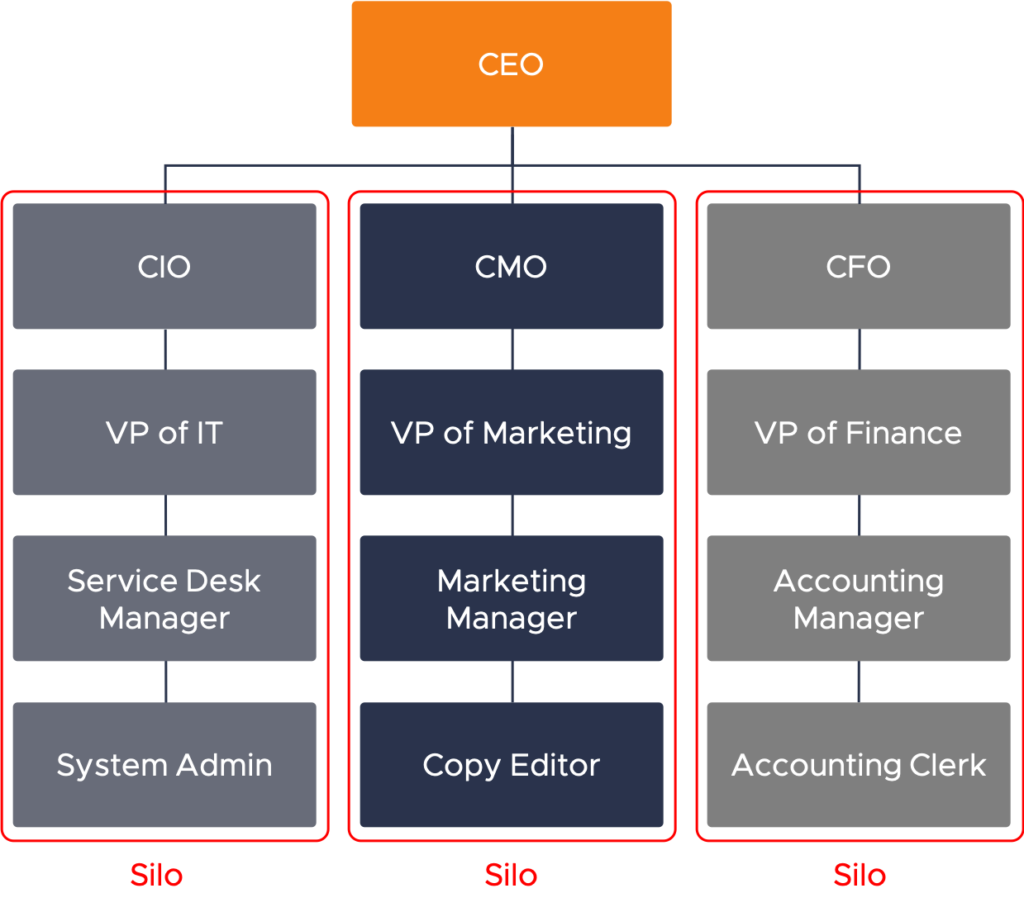
Most organizations operate in silos, with teams largely isolated from one another. This isolation causes teams and individuals to lose sight of what others are doing – and the big picture of what the work is leading to.
Do we need silos in organizations? In a sense, yes. We need teams that are specialized in different areas and serve as subject matter experts. However, when people work in isolation, we see a problematic amount of variability in how teams or departments work. It also makes it more difficult for work to flow properly.
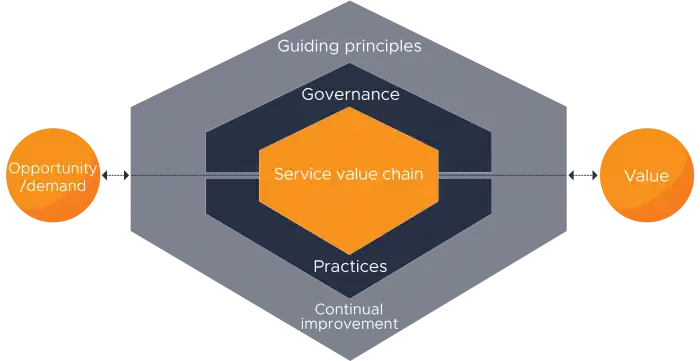
The Service Value System (SVS) is a different way to think about the organization. Remember the definition of a system: a set of things working together as parts of a mechanism or an interconnecting network. The Service Value System is interconnected. It has individual parts; but they are all part of the same network, working together. This includes how we actually get things done (Service Value Chain), how we make decisions (Guiding Principles), how we improve (Continual Improvement), how we ensure we’re doing what we say we’re going to do (Governance), and how we process work (Practices). Ultimately, the most successful organizations are the ones that can effectively capitalize on opportunities and demand by delivering high-quality products and services quickly. They are the nimblest organizations, and they do it by breaking down silos. Here’s a diagram of the Service Value System and its component parts. Next, we’ll break down those components and discuss how each contributes to making the Service Value System successful.
An organization’s underlying values and beliefs (should) drive everything they do. Well-defined, enduring guiding principles instill the right mindset in our teams when they’re making decisions. ITIL has created 7 guiding principles, pulled from frameworks such as Lean, Agile, etc. that provide guidance around how to implement IT Service Management in our organization.
Just because there’s a speed limit doesn’t mean people are going to follow it. We police officers have to set speed traps, put up cameras, and post speed limit signs as reminders. That’s what governance does – it gives us the speed limit and ensures we’re following it.
Our clients come to us because they expect exceptional products and services. An effective and efficient way of working, like the Service Value Chain, is what helps organizations maintain that standard of excellence. Let’s start with a few definitions:
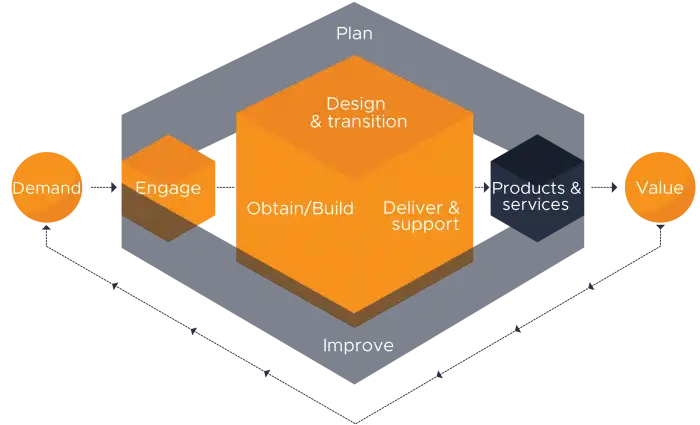
The input into the SVC is Demand – the output is Value in the form of products and services. Between the input and output are six activities: Plan, Improve, Engage, Design & Transition, Obtain/Build, and Deliver & Support. Below, I’ve included a brief description of each. As you’re reading through the descriptions, you’ll notice they’re quite generic – that is intentional. Each activity can apply to any organization – large or small, public or private – that creates products and services. They’re also iterative and do not need to be performed in the exact order they’re listed below; they can be done in any order or combination.
The Plan activity ensures understanding of the vision, current status, and improvement direction for all four dimensions of Service Management, as well as products and services across the organization. This includes planning at all levels of an organization.
The purpose of the Improve activity is the continual improvement of products, services, and practices across all the Service Value Chain activities and the four dimensions of Service Management. All improvements at all levels are initiated and managed here.
The Engage activity provides understanding of stakeholder needs, transparency, and good relationships with stakeholders. All incoming and outgoing interactions are performed here.
Design & Transition ensures services and products meet stakeholder expectations, considering quality, cost, and time-to-market.
The Obtain/Build activity is responsible for ensuring all service components are available when and where they’re needed, and that they meet the agreed specifications. All new resources are obtained here.
Deliver & Support gets services and products to the customer, ensuring delivery meets agreed-upon specifications and the stakeholders’ expectations. This is where customers see value.
A value stream is a series of steps an organization undertakes to create and deliver products and services to customers.
Each activity that takes place within the value stream (see table below) transforms inputs and outputs using practices. As mentioned above, the Service Value Chain activities are not linear – they can be completed in any combination or order. The combination and order of the Service Value Chain activities are defined in value systems.
A value stream is linear. It represents the steps we take – our journey through the Service Value Chain – to create our products and services. To illustrate this, let’s use an example.
It is discovered that there is no Wifi coverage in one area of the warehouse. This means a forklift driver must drive across the warehouse to pick up their instructions on their tablet, causing delays and risking missed business deadlines. The forklift driver alerts the warehouse manager of the issue and that delays will occur with loading materials today.
The warehouse manager phones the service desk and describes the issue: a forklift driver is unable to access the application on the tablet to receive instructions. It is agreed that this is a Priority 2 incident, and the manager is notified of the expected resolution time. Information about the incident is logged by the service desk agent, and a ticket is created in Cherwell, the IT department’s ticketing system.
This is a Priority 2 Incident ticket, so the Service Level Agreement (SLA) to resolve it is two hours. The agent determines they cannot resolve the incident and escalates the ticket. Based on the reported description of the issue, the agent escalates this to the field technician supporting the warehouse to potentially replace the tablet.
The field technician receives a notification on the smartphone as soon as the Priority 2 ticket hits their queue in ServiceNow. The technician wraps up with the customer they are assisting and heads to the storage room to grab a new tablet. When the technician arrives at the warehouse, it is discovered that the issue is not, in fact, the tablet, but the wireless access point. Now, we are rapidly approaching the 2-hour SLA target resolution time. The field technician now has to reassign the ticket to the network support team. When the incident ticket hits the network support engineer’s Cherwell queue, the SLA has been breached.
The network support engineer identifies that the wireless access point has failed and replaces it with a spare from the storage room. This is a standard change, so the engineer needs no additional approval. Information required to configure the new access point is obtained from Cherwell. IT asset information is updated to show that this spare part has been consumed.
The network engineer thinks about what happened and whether they could have predicted this issue or resolved it more quickly.
The service desk agent contacts the warehouse manager to check that everything is now working properly, then closes the incident.
WiFi coverage is restored and the forklift driver can now work efficiently.
A brief satisfaction survey is emailed to the warehouse manager, which they complete and return. The scores are used to identify trends, and the comments are passed to the service desk manager for consideration.
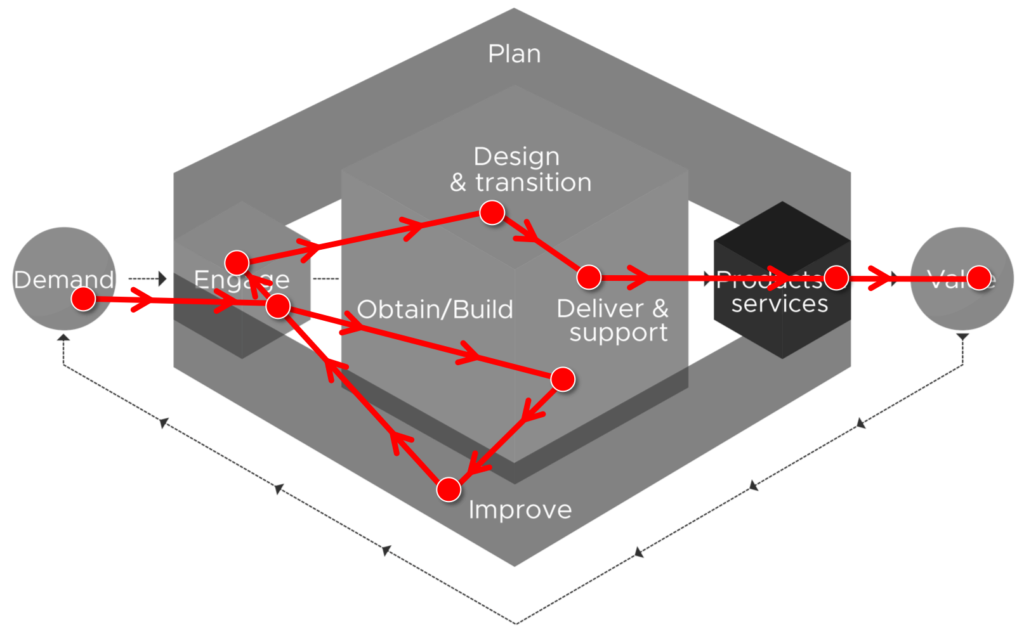
As shown in the graphic above, a value stream moves through the SVC in any order and in any combination.
The purpose of looking at a value stream is that it gives us a holistic view of what is happening. If we don’t look holistically, we won’t be able to uncover waste, eliminate activities that have no value, or work to improve at the organizational level.
The Service Value System is how our entire organization works together to create value for our consumers. We are trying to enable flexibility, discourage siloed thinking, and always look at the whole. By doing this, we can take the value stream we started above and improve it by making sure we are escalating to the proper team from the start (among other things). We can also add the practices that take part in each activity.
And there you have it – the service value system, comprised of the service value chain, guiding principles, and governance can help your organization deliver higher quality products and services to your customers by maintaining a holistic, end-goal-oriented perspective.