
Understanding the Common Service Data Model (CSDM) in ServiceNow
The Common Service Data Model (CSDM) serves as a unified framework that helps organizations manage and illustrate their services and related data…


Artificial intelligence now touches almost every corner of business operations, from generating knowledge articles to forecasting demand and assisting frontline teams. But as organizations introduce more models, skills, agents, and workflows, many quickly realize they do not have a complete picture of what exists, who owns it, or how it behaves over time. AI adoption is rising faster than the structures needed to manage it, which leaves gaps in oversight and creates uncertainty about long-term reliability.
The ServiceNow AI Control Tower was created to close those gaps. It gives organizations a single environment to understand where AI is operating, how it is performing, and what responsibilities come with keeping it healthy. Instead of letting AI grow in pockets across different departments, Control Tower brings AI work into a unified and traceable system, which allows teams to scale AI responsibly without slowing momentum.
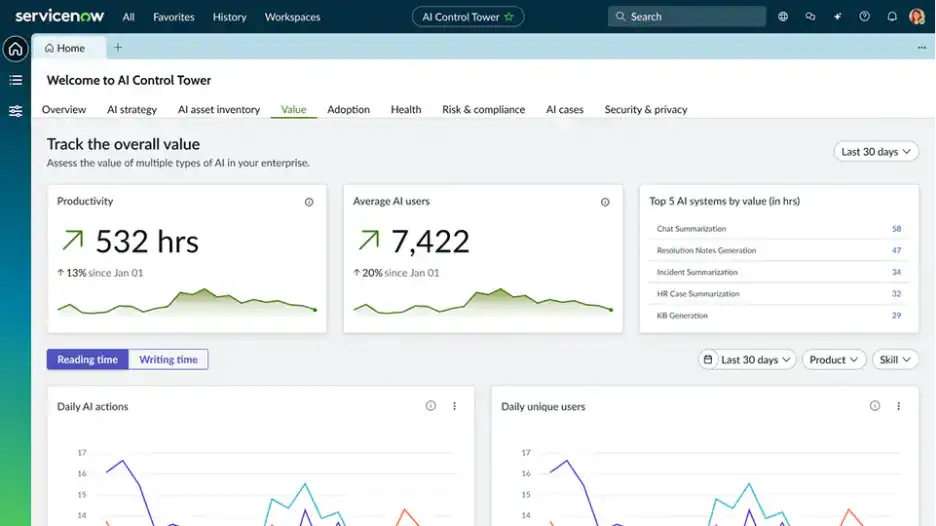
Most organizations do not intentionally choose to “skip” governance. What usually happens is that individual teams solve immediate problems with AI tools that are easy to access and quick to implement. A model that routes tickets more efficiently, an assistant that summarizes customer conversations, or a forecasting script built by a power user can deliver instant value. But without coordination, this speed creates uneven practices and parallel solutions that live outside formal oversight.
This is where governance becomes essential. AI governance is not an extra layer of bureaucracy; it is the set of practices that ensure AI systems are understandable, traceable, and aligned with the organization’s goals. It helps answer fundamental questions: What AI systems do we have? What data do they rely on? How do we know they are still performing well? What risks do they introduce if they change, degrade, or behave unpredictably?
With proper governance, AI becomes a strategic capability rather than a collection of isolated tools. It becomes clearer how each model fits into business operations and how it contributes to reliability, service quality, and customer experience.
Before organizations implement a platform like AI Control Tower, it helps to understand where they currently stand. Our AI Readiness Assessment gives teams a structured way to evaluate their capabilities across strategy, data, technology, people, and governance, and to identify the gaps that may impact AI adoption. This baseline often becomes the foundation for a more successful and sustainable governance program.
The AI Control Tower translates governance principles into daily operational practice. It creates a central inventory of all AI assets across the organization and shows how each model, assistant, or dataset connects to the services they support. For ServiceNow customers, this immediately feels familiar because it builds on the same foundations that underpin configuration management and service mapping.
This single source of truth solves a challenge many organizations face today: AI systems are often known only to the teams that built them. Control Tower makes ownership, dependencies, and performance visible to everyone who needs to understand their impact. When a model begins to drift or a dataset becomes outdated, the right people can take action before the issue affects customers or service levels.
The platform also provides a consistent way to introduce new AI capabilities. Workflows guide teams from idea to approval to deployment using a structured process rather than informal conversations or independent development efforts. This replaces guesswork with clarity and creates the transparency that both operational teams and leadership expect.
AI governance is continuous. The Control Tower supports each stage of an AI system’s life:
This structured lifecycle replaces ad-hoc oversight with repeatable, trackable processes.
Most ServiceNow customers already have mature processes in place for service management, operations, security, and compliance. When a new capability appears, especially one as far-reaching as AI Control Tower, the first reaction is usually not excitement, but caution. The questions that come up are practical: What does it require? Will it complicate current workflows? How much effort is needed to get value out of it? These concerns are reasonable, and understanding them can help teams prepare for a smoother rollout.
For many ServiceNow users, the biggest unknown is how much groundwork must be in place before the control tower becomes useful. Because the platform relies on the CMDB to map AI assets to business services, organizations with a healthy CSDM implementation will be able to realize value more quickly. Teams with a fragmented CMDB can still use the tool, but they may need a short runway to clean up foundational data.
There is also curiosity around integration. Many organizations use a mix of AI systems, including models built outside ServiceNow or embedded within SaaS tools. Control Tower does not require everything to be rebuilt on-platform, but it does require a consistent way to document those external assets. For some teams, this creates a new opportunity to consolidate information that was previously scattered across teams, spreadsheets, and ad-hoc repositories.
Another common concern among ServiceNow users is whether implementing governance will create bottlenecks for teams that want to move quickly. It helps to point out that the goal is not to add layers of approval but to replace unclear, inconsistent review processes with predictable ones. Instead of slowing down projects, well-designed intake and assessment workflows often accelerate them by reducing confusion and rework.
Because the governance model is risk-based, organizations can choose to apply lightweight processes to low-impact use cases. For example, a generative AI assistant for internal knowledge searches may require minimal formal oversight, while an AI model that influences customer entitlements may require a deeper review. This flexibility is reassuring for teams that want to experiment without introducing unnecessary friction. It’s an enabler, not an impediment, to organizations that strive to foster a culture of innovation.
One of the strengths of the AI Control Tower is that it feels familiar to long-time platform users. Its structure builds on existing concepts such as:
For many teams, this familiarity reduces the learning curve. Rather than adopting an entirely new toolset, users extend established patterns into the AI domain. This continuity helps organizations maintain consistency across their governance practices.
ServiceNow users often ask what the ongoing burden will be once Control Tower is live. AI governance is not a “set it and forget it” effort, but the platform does much of the heavy lifting. Monitoring dashboards pull in performance data, drift indicators, and compliance flags automatically once data pipelines are connected. Lifecycle stages guide teams to review and refresh documentation at predictable intervals.
The main responsibility becomes ensuring that teams follow the defined processes. As with any governance framework, the effectiveness comes from consistent participation, not the tool alone. Organizations that identify clear ownership roles early often see the strongest long-term results.
Governance sounds abstract until you break it into practical steps. Control Tower provides a structured lifecycle that turns policy into daily operations.
Intake is the front door for AI ideas. It gives teams a structured way to propose new models or agents while capturing the information needed for early evaluation. Instead of relying on hallway conversations or ad-hoc tickets, intake creates a clear starting point that establishes purpose, expected value, data sources, assumptions, and potential risks.
For ServiceNow users, intake functions like any other structured request workflow: it routes to the right reviewers, enforces consistent information capture, and creates traceability from idea to implementation.
With intake workflow: A customer service team wants to introduce an AI summarizer to help agents produce clearer case notes. Intake requires them to document what success looks like and what data the model will rely on. Leadership can understand effort and potential risks early, ensuring the project aligns with service quality goals and won’t introduce compliance issues.
Without intake: Different teams may start building their own summarizers with no shared standards, inconsistent training data, and duplicative work. Leadership only learns about them when results vary between groups or when a poor output reaches a customer.
Assessment formalizes the review process that many organizations currently perform informally. It evaluates proposed AI initiatives for fairness, security, regulatory alignment, data quality, and feasibility. For teams using ServiceNow’s risk and compliance tools, this step integrates naturally with existing workflows.
Assessment protects the organization from costly surprises. It ensures that potentially harmful or non-compliant designs are identified early rather than after they have already influenced decisions or customer experiences.
With assessment: A financial services team proposes a credit-approval model. During assessment, a risk review identifies that the dataset includes sensitive demographic fields that could introduce bias. The team reworks its approach before development proceeds, preventing a future compliance issue.
Without assessment: The model launches and performs adequately at first. Months later, auditors discover that decisions are being influenced by attributes that should never have been included. The organization faces corrective actions, reputational risk, and an urgent model rollback.
Deployment ensures that approved AI systems are introduced to the environment in a controlled and documented way. This is where the Control Tower connects AI assets to the CMDB, ties them to business services, captures their dependencies, and identifies who owns ongoing maintenance.
For ServiceNow users, this stage aligns with standard release management practices. It clarifies how AI systems move from development to production and ensures that the right oversight is in place from day one.
With structured deployment: An AI assistant is developed to triage IT tickets and extract key information. During deployment, it is linked to the ITSM service within the CMDB. Platform owners now know which workflows rely on the assistant and can measure how it affects resolution time and agent workload.
Without structured deployment: A developer embeds the assistant directly into a workflow without documenting it. When the assistant malfunctions or starts producing inconsistent outputs, no one knows where it lives, who owns it, or which processes depend on it. Troubleshooting becomes slow and costly.
AI systems change over time. Data shifts, patterns evolve, and user behavior adapts. Monitoring is how organizations ensure their models remain reliable. The Control Tower centralizes performance metrics, drift indicators, accuracy checks, and usage analytics so owners can see when a model needs attention.
Monitoring is especially important for ServiceNow customers who rely on AI to support critical operational services. A small decline in model accuracy can cascade into service delays or customer frustration if left unaddressed.
With monitoring: A resource forecasting model used in IT operations starts drifting as the organization enters a new seasonal cycle. Control Tower identifies a decline in prediction accuracy and alerts the model owner. The team retrains the model proactively, avoiding staffing shortages during peak workloads.
Without monitoring: The same model grows increasingly inaccurate. Teams continue to rely on outdated predictions, leading to overstaffing at slow periods and understaffing during surges. The issue is only discovered after service performance drops.
Every AI system has a lifespan. Retirement ensures that outdated, inaccurate, or redundant models are removed cleanly. Clear retirement processes prevent old models from lingering in workflows where they can create confusion or unintended consequences.
In ServiceNow environments, retirement maintains the integrity of the CMDB and prevents technical debt. It also helps teams understand which AI investments are still delivering value.
With retirement: A knowledge-article summarizer becomes unnecessary after a platform upgrade that incorporates native summarization features. The team retires the old model with proper documentation, updates related workflows, and removes dependencies from the CMDB.
Without retirement: The summarizer remains active for years out of habit. It occasionally conflicts with the new native features and produces inconsistent results. No one can easily explain why it still exists or whether it should be supported.
Taken together, these practices create the structure organizations need to guide AI responsibly and prepare for the continued expansion of AI across the enterprise.
As organizations deepen their use of AI, the need for clarity, coordination, and shared responsibility becomes increasingly important. The ServiceNow AI Control Tower offers a practical way to bring those elements together by giving teams a common view of how AI is being deployed and how well it is performing. With stronger visibility, consistent processes, and a focus on real business outcomes, organizations can move from scattered experimentation to a more thoughtful and sustainable approach to AI. It is this kind of steady, well-supported growth that helps AI deliver meaningful value over time.