
Understanding the Common Service Data Model (CSDM) in ServiceNow
The Common Service Data Model (CSDM) serves as a unified framework that helps organizations manage and illustrate their services and related data…


Even for experienced ServiceNow professionals, understanding where AI fits into day-to-day work can be challenging. The technology is advancing quickly, and many architects and administrators are asking the same question: how does AI actually apply to the work we do today?
In this article, we’ll explore that question through a practical lens, looking at when to use ServiceNow AI skills, when to deploy AI agents, and how real organizations are combining both to simplify complex workflows without starting from scratch.
To understand where AI fits, it helps to look at how automation in ServiceNow has evolved.
In the early days of automation, every new advancement came with a question: would it replace people or help them do more? When ServiceNow introduced routing rules and early workflow automation, some worried the frontline would disappear. It didn’t. The repetitive work simply shifted left, and people moved up into analysis, engineering, and problem prevention.
That same evolution is happening again. ServiceNow has always been about making work faster and easier, and AI builds on that foundation. Instead of just automating individual steps, it connects data across systems, makes context-aware decisions, and even resolves issues automatically, setting the stage for autonomous support, where systems can detect and address issues proactively while people focus on higher-value work.
That’s where ServiceNow’s AI skills and agents come in, providing the capabilities that bring this next phase of automation to life.
When organizations begin exploring AI-powered automation in ServiceNow, one of the first questions is when to use a skill versus an agent. They work together but serve very different purposes.
Understanding how these work together is the first step toward scaling AI in ServiceNow effectively.
Skills are single, targeted actions that perform a specific task. They’re designed to be quick, reusable, and easy to integrate into other workflows. Think of them as building blocks for AI in ServiceNow.
Examples of ServiceNow AI skills include:
Because they’re narrow in scope, skills are fast to deploy and test. They also lend themselves to reusability. The same data anonymization skill built for privacy requests can be reused in offboarding or vendor contact cleanup — same action, new context.
Agents are the orchestrators. They tie multiple skills (and sometimes other automated steps) together into a multi-step, cross-system workflow. While a skill completes one action, an agent manages the bigger picture.
Examples of agent-driven processes include:
Agents are ideal when:
Rule of thumb:
In practice, most ServiceNow AI use cases need both. Skills handle the discrete actions, while agents orchestrate them into a cohesive workflow.
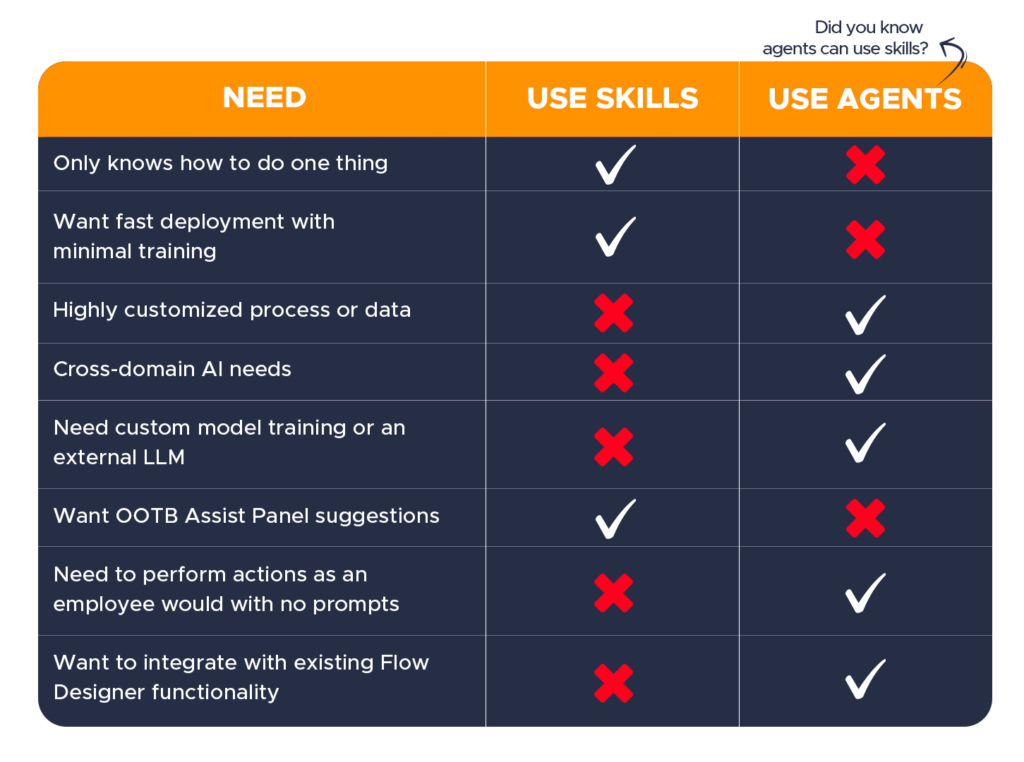
Understanding this distinction is critical for any ServiceNow AI strategy. Build everything as an agent, and you’ll reinvent the wheel for each new use case. Focus first on reusable skills, and you’ll create a scalable library of building blocks that agents can call on to deliver more sophisticated automation.
Think of it like this: we didn’t write new routing logic for every queue; we created one great rule and reused it. Skills are those rules, and agents are how you string them together when the path forks.
Let’s look at how this works in practice with a common request many organizations face.
Meet Mary. Mary won the lottery, so will be parting ways with her employer. On the way out, she asks that her personal data be removed from company systems. Simple on paper, complex in reality.
Breaking Down the Process
Designing Mary’s Solution
If you already have a privacy process in place, you don’t need to start over. Replace manual case tasks with skills and let an agent orchestrate the flow. You keep your governance, eliminate the swivel-chair work, and gain the same kinds of results Mary did.
The outcome is faster execution (Mary gets a confirmation email in seconds rather than days), fewer handoffs, and a complete audit trail, while reusing the same skills used in related workflows such as privacy requests, employee offboarding, or vendor contact cleanup.
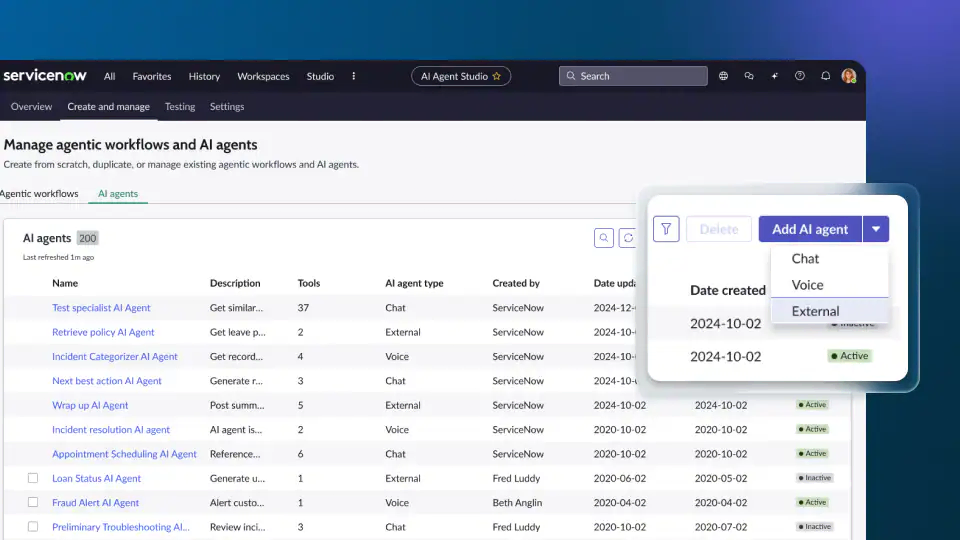
The same approach outlined above applies to nearly any process.
Start small, test, and grow:
Each small win builds momentum and creates the foundation for your broader ServiceNow AI strategy.
Today, skills and agents handle tasks and orchestrations. Tomorrow, they’ll form the backbone of how organizations design end-to-end digital services.
Many of these AI capabilities are already taking shape in the ServiceNow Zurich release, which expands the platform’s generative AI features and continues to refine how skills and agents work together.
Imagine a library of proven, tested AI skills that any business unit can plug into their workflows, with agents acting as the connective tissue across departments and platforms. That’s where AI-powered ServiceNow is heading, focusing less on isolated automation and more on building a unified, adaptable fabric of business processes.