
An Overview of ITIL 4 Digital and IT Strategy (DITS)
02/02/2023
| By Erika Flora
What is “ITIL 4 Leader: Digital and IT Strategy”?
The “ITIL 4 Leader: Digital and IT Strategy,” (DITS for short) book is one of a handful of official Axelos ITIL 4 publications, each of which have a different set of global authors. There is an associated 3-day DITS certification course, which includes practical assessments and an exam, described in detail below. This article will provide an overview of frequently asked questions around the DITS book, including why it’s an essential read for digital leaders, a summary of some of my favorite topics, and specifics on the course, practical assessments, and the 30-question exam.
Why should you care about the DITS book?
Every organization must continue to remain relevant in these fast-moving, uncertain, complex, and volatile times we’re living in. Digital transformation and evolution are even more vital to an organization’s survival now that, with COVID, customers are placing more of an emphasis on digital products and services that are affordable, rapid, cloud-based, and dependable. This book answers some key questions like:
How do we develop a digital strategy to keep from becoming obsolete?
How do we leverage technology to radically change the customer experience?
How do we know if we should invest in a new technology or if it’s just a fad?
The DITS book, written specifically for digital leaders, provides insight into what the best digital organizations get right as well as the pitfalls to avoid when approaching a digital transformation. Regardless of your role within an organization, there are lots of ideas, tools, and techniques contained within the DITS book that will help you, your team, and your organization improve how products and services are designed, developed, delivered, and improved.
How is the DITS book structured?
The book is broken up into three parts. The first section, Part I, provides an overview of fundamental digital strategy concepts and provides clarity around several terms like digitization and digital transformation, defined here:
Digital Transformation: the use of digital technology to enable a significant improvement in the realization of the organization’s objectives that could not feasibly have been achieved by non-digital means
One of the things I really like about the book is that it clarifies what is meant by the term “digital transformation” as different people often tend to look at these words differently. In fact, it is often much bigger and impacts more areas of our organization than what we may think. If done well, a “digital transformation” impacts not only how we work, but how we lead, how our organization is structured, and how we serve our customers (as shown below).
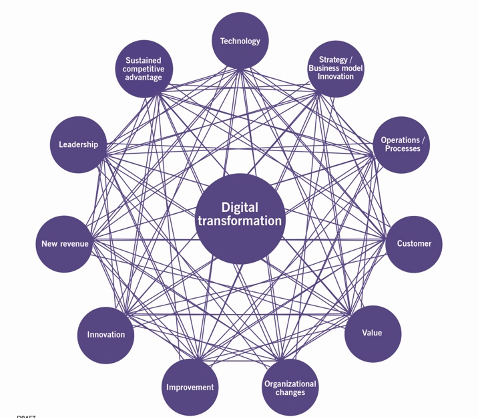
Digital Transformation Components
The second section, Part II, organizes topics according to the Continual Improvement Model, starting with “What is the vision?” as shown below and provides lots of templates, tools, and techniques that can help an organization in any phase of its digital transformation journey (more on that later).
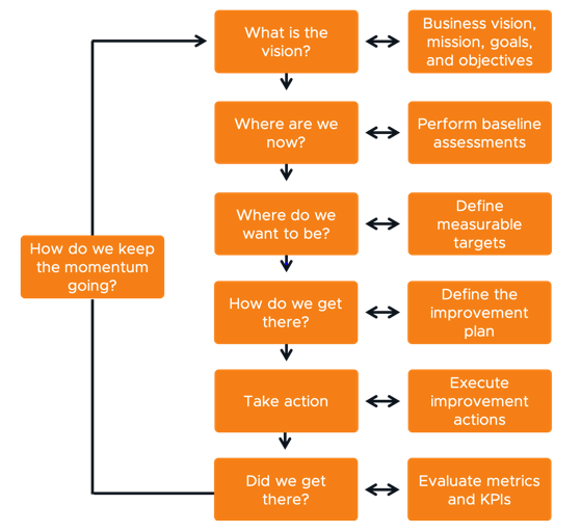
Seven-Step Continual Improvement Model
Part III covers key capabilities of a digital organization, including the characteristics of effective digital leaders, ways to foster an innovative, agile, and resilient culture, how to assess whether emerging technologies are relevant to our organization, and ways to better understand, analyze, and manage digital risks at a strategic level.
What topics are covered in the DITS book, course, and exam?
The digital strategy concepts in the DITS book come from extensive industry research and interviews with digital leaders across a diverse range of organizations. As a result, several concepts are completely new to the ITIL library. Here are five of my favorite topics along with the book chapter in which they’re covered:
Crafting a compelling digital vision (chapter 3). This is one of my favorite chapters as it’s a critical starting point for any organizational transformation, digital or otherwise. Unfortunately, it is also one of the most underutilized and overlooked keys to our success. We, as leaders, don’t often take the time to create a compelling digital vision, resulting in a transformation effort that isn’t as successful as we had hoped. It often feels like an unnecessary step and, yet, changing how our organization fundamentally works requires a dramatic shift in our teams’ behaviors; and to do that, everyone must understand and embrace the urgency of change. A simple, clear, and concrete statement on the “why” and the “why we need to do it now” can serve as a “north star” in our transformation efforts and makes the rest of the journey easier. Further, if we can we pair our digital vision with an equally impactful visual picture to supplement our words, it gives us a way to plainly and rapidly explain the vision; and it gives our teams a better way to remember it (pictures being worth 1,000 words and all). For example, we often use the Beyond20 Digital Positioning Model to help leaders create an image that helps leaders explain (and teams understand) the direction an organization is headed.
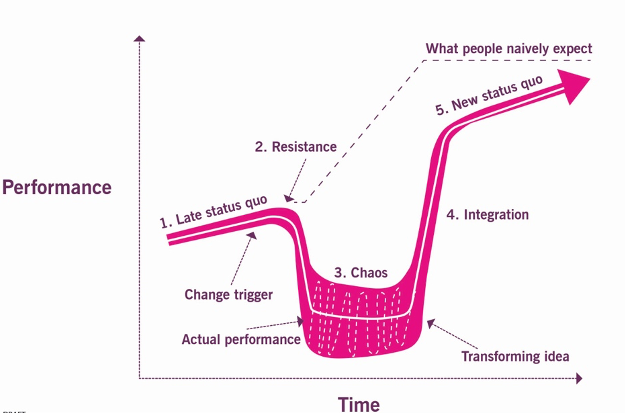
Implementing large-scale and incremental digital transformations (chapter 6). This chapter gives guidance on how we, as leaders, take our strategy and begin to execute a digital transformation. The book outlines different options, challenges, along with the hazards to avoid with each approach. One of the concepts that I’m glad made it into the book is that of the Satir Change Model (pictured below), which shows the path that organizations go through when implementing major change. It’s helpful to understand that how we anticipate change will happen compared to how change actually happens are two very different things. As a result, we as leaders must prepare ourselves and our teams for the resulting chaos, resistance, and inevitable failures along the way. In fact, teams will actually become slower before they become faster when forming new habits and doing work they’ve never done before; and we need to be ready to address it and help our teams through it. Change is not for the faint of heart, but the fight, if we stick with it, will be worthwhile.
The Satir Change Model
Parallel operating models (chapter 8). This chapter answers the question of how we, as leaders, on the path to launching a digital business, simultaneously manage these two different business models without putting ourselves out of business. Essentially, we are trying to change the engines while still flying the plane. This chapter talks about the fascinating concepts of cannibalism, erosion, concurrence, and synergism and uses industry examples like the New York Times, Apple, and Netflix to explain each approach.
Characteristics of an effective digital leader (chapter 9). To me, this chapter is really exciting as it comes from our interactions, observations, and research on digital leaders and discusses the characteristics and skills they exhibit. Some of these traits include things like having a “digital mindset”, putting a focus on training and education (for ourselves, our peers, and others within our organization), and taking the time to build trust through relationships. Even when we’re dealing with digital technology, our work as leaders is deeply human. The good news is that these are skills that any of us, as digital leaders (or aspiring leaders), can practice and develop – ultimately improving ourselves, our teams, and our organizations.
Fostering an innovative culture (chapter 10). We wrote this chapter to clarify what innovation is (and is not), why it’s vital to the long-term success of an organization, and how to create an environment that fosters and supports the development, vetting, and launch of innovative products and services. There are some interesting approaches included in the DITS book, including crowdsourced innovation and continuous learning. Check out this article on digital innovation for more detail on this topic.
There are other great tools and techniques in the DITS book that can help us re-imagine, plan, and execute our digital strategy, including: Wardley Maps (pictured below), which help us gain “situational awareness” of our current position and inform our strategic direction, Business Model Canvases, the Cynefin framework (which gives decision-making guidance across a variety of situations), and Objectives and Key Results or OKRs (which help us quickly define our organization’s goals and measure our teams’ results against it).
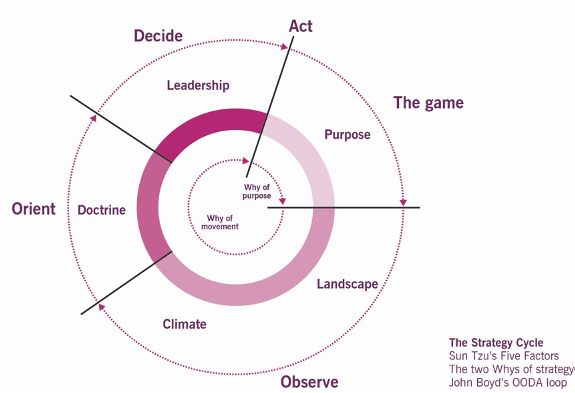
Wardley Map Strategy Cycle
SHARE
Latest Posts
Check out some related resources to go deeper on these topics and put these ideas into action.